Article originally posted AGC Houston Cornerstone Winter 2025-2026
IN A CAVERNOUS WAREHOUSE tucked nearly into a nondescript industrial park on Houston’s outskirts, workers in safety vests weld steel frames and assemble wall panels.
Unaffected by rain or traffic, forklifts zip around incessantly, materials arrive on schedule, and the production crew consistently churns out components like clockwork. Every screw and seam is inspected before the next shift clocks in. Within weeks, these precision-built modules will be trucked to a downtown construction site, craned into place, and locked together to form an entire hotel floor – all before lunch.
Prefabrication and modular construction aren’t new ideas, and they are no longer niche technologies. Now, they’re powerful tools reshaping how Houston’s commercial contractors deliver projects. Whether it’s for towering hotels, hospitals, data centers, multifamily developments, or other projects, builders are using off-site fabrication to reduce jobsite waste, shorten schedules, stabilize supply chain volatility, and improve quality control.
What started as a specialty method is now a mainstream movement with the benefits of mass production. From flat-packed framing and floors to panelized plumbing, complete pods, or even fully-finished structures, modular construction is revolutionizing how construction gets done. And, for many general contractors, it’s the next step toward sustainable, smarter, leaner building with a focus on efficiency and profit.
“Most of the prefabrication components we see are sections of walls – frame and sheetrock or drywall that’s pre-cut and pre-installed,” said Saied Alavi, senior vice president of prefabrication and modular construction at MAREK. Often fulfilling orders for more than 500 identical components, MAREK delivers finished panels that are placed on the framing and simply screwed into place, often with substantially better fit and finish than what could be accomplished in an uncontrolled environment on-site. “We have hospital projects that we’ve been able to save upwards of $2 million in drywall alone.”
Speed Counts
The construction market, including Houston, has always valued speed. Of course, developers aim for occupancy as quickly as possible to start generating revenue, and general contractors face constant pressure to deliver faster without compromising quality. With the addition of complications like rising labor costs, supply chain instability, and stricter environmental expectations, getting things right the first time becomes even more crucial.
Prefabrication, however, helps solve those challenges by moving construction activities from the field into the factory, into controlled environments designed to cut waste, compress schedules, and reduce reliance on hard-to-find skilled trades; frustration is replaced with convenience.
White site prep is going on, and foundations are formed on location. The fabrication of wall panels, bathroom pods, or MEP racks happens concurrently – that overlap shortens project timelines, smooths workflows, and mitigates the chaos that often plagues complex builds. “We even fabricate components to keep on our shelves, so if someone needs 20 pieces of something, we usually have it pre-cut and pre-packaged; that way, the foreman can come by and pick up whatever they need,” Alavi said.
Multiple Methods
Prefabrication isn’t just one method, but rather a variety of approaches, such as modular construction (where sections or even entire rooms are built off-site); completely finished unit “pods”; or panelized systems like walls, floors, or MEP racks that arrive on-site ready for installation.
“MAREK is primarily a drywall interior contractor, but MEP, prefab has been quietly used for decades,” Alavi said. Companies like MAREK are single-trade prefabricators that supply finished bathroom pods and complete framing, plumbing, or electrical components. “The more work we do to collaborate together as multi-trades, the bigger impact we will have in the adoption of modular construction – and that’s starting to take place more often, especially with the skilled workforce shortage.”
In Houston, contractors are using these strategies more and more often.
“Jobsite productivity improves with prfab and modular methods too.”
For example, a recent facility built near the Texas Medical Center used modular bathroom pods and prefabricated MEP assemblies, which resulted in faster installation, better quality control, and fewer jobsite bottlenecks, while a data center in Katy relied on pre-assembled electrical skids to speed things up. In each case, the use of off-site fabricated components resulted in cleaner sites, faster installations, and quality levels that are impossible to achieve under open skies.
Quality is Key
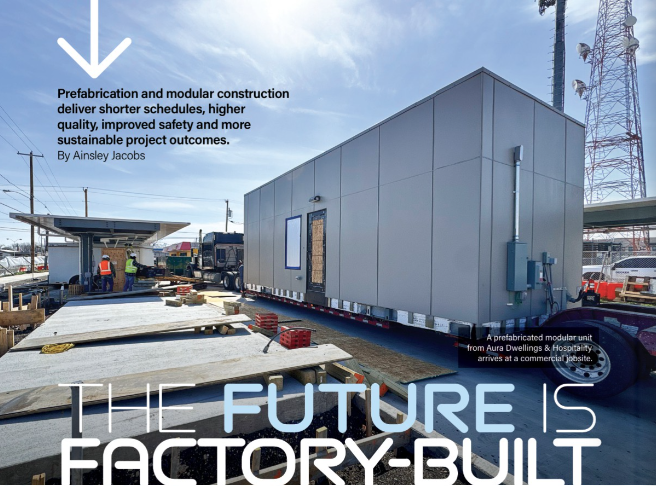
“People have a perception of modular being not quite the same quality you can get with on-site construction, but they’re amazed at the quality we can produce,” said Rame Hruska, a co-founder and CEO of Aura Dwellings & Hospitality, a prefabrication company specializing in homes, offices, and hospitality projects that ships its offerings nationwide.
To the surprise of many, though, using standardized components doesn’t mean sacrificing aesthetics. “Modular construction can be used for high-end projects, too. In the end, that’s the point – it doesn’t look any different than site-built.”
Of course, architects play a crucial role in enabling this integration. Early coordination between designers, engineers, and fabricators is critical to ensuring every component aligns precisely once delivered.
“If we change a project later on to take advantage of prefab, it may require changes to the design that result in more costs, so we want to plan as early as possible,” Alavi said.
Although gaining acceptance of such a front-loaded design process can be a hurdle, as planning and collaboration need to take place, often before a single yard of concrete is poured, it ultimately saves time and cost in the long run, thanks to tighter tolerances and fewer surprises.
Additionally, in Texas, prefabrication is regulated by the state, and manufacturers need to have their factories certified. “The regulatory piece comes with requiring more engineering drawings and a lot of upfront work, so itmakes sense to spread that work across a larger project with repeatable components,” Hruska said.
Consistency
One of the biggest benefits of prefab is consistency, as factory-controlled environments allow for standardized quality checks, precision tools, and consistent working conditions, including temperature and lighting – all of which is often a stark contrast to Houston’s sweltering, storm-prone jobsites.
“When we first got into modular, we focused on quality control to assure we were delivering projects that were done the right way,” Hruska said. In the field, it’s difficult to be able to inspect every flashing and detail, every area that could have water penetration, but factory-based construction changes that. “We have a constant monitoring process in place for continuous inspection across the entire production process, including plumbing and electrical, before it leaves the factory.”
That predictability, which translates into fewer defects and less material waste, also results in improved safety and workforce stability. Instead of climbing scaffolds in 100-degree heat, crews work on level floors with predictable hours. For contractors, that translates into lower insurance exposure and a strong ability to retain skilled labor.
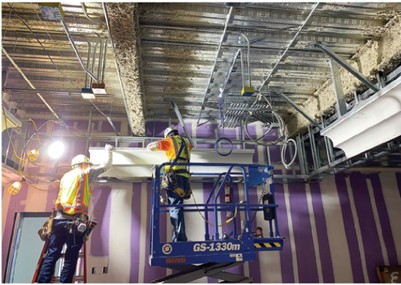
“Safety is improved because you need fewer people on the jobsite with prefabrication. On-site fabricaitonmeans cutting parts and pieces – whether it’s framing or sheetrock – and that means sharp blades and saws,” said Alavi, who knows that mistakes can cause accidents and injuries, and moving these tasks from the jobsites to a prefabrication-focused environment reduces the opportunity for accidents. “Plus, a lot of traditional work is on scissor lifts or ladders, so prefabrication helps cut down the time spent up in the air.”
Productivity Benefits
Jobsite productivity improves with prefab and modular methods, too. Fewer material deliveries cut congestion and emissions, while reduced rework keeps schedules tight. For dense urban projects, like in downtown Houston or near the Texas Medical Center, less site clutter is a major advantage. And, the quiet efficiency of modular installation makes even urban infill projects more manageable.
“We build volumetric modular – not just flat-pack pr panelized components, but fully-completed modules, inside and out, either single units or multi-module projects that piece together like Legos,” Hruska said, pointing out that hospitals and hospitality projects generally benefit well from prefabrication due to the number of reteable units. “It’s not limiting in terms of what you can do; you just have to break a building down into parts and ship it in pieces.”
While speed and cost often headline prefab’s advantages, sustainability may prove to be its most enduring legacy, geared towards the greater good. Houston’s commercial builders are under growing pressure from clients looking for LEED (Leadership in Energy and Environmental Design) certification – a globally recognized green building rating system – as well as ESG (Environmental, Social, Governance) reporting goals and carbon-neutral targets, and prefabrication directly aligns with all of those efforts.
By manufacturing in bulk to minimize waste – reducing the impacts of redundant transportation and improving energy efficiency during production – prefab systems deliver substantial sustainability gains. Additionally, some Houston-area facilities have even integrated renewable energy and closed-loop recycling into their fabrication process.
And, because modules are built to tight tolerances, the completed structures often have better thermal performance than their constructed-on-site counterparts, which reduces the overall operational energy use long after construction is complete.
Despite its momentum, though, prefab adoption still faces some hesitancy in regard to acceptance, especially in Houston’s market. Clients worry that modular buildings may look like uninspired “cookie-cutter” carbon copies, while others question the upfront cost or logistical complexity of transporting large modules through Houston’s crowded freeways.
“Our field people didn’t think prefab gave them enough control over the job, so it was up to us to show them the benefits, including that a job can be finished on time,” Alavi said. “We did a project around 2018 in Houston that had some budget constraints, and we helped them save $1 million by suggesting they use bathroom pods.”
Winning Acceptance
Winning the acceptance of general contractors also means overcoming the traditional build-on-site mindset. Historically, procurement and financing structures haven’t been designed to accommodate prefab workflows, which require both earlier design finalization and earlier up-front payment for off-site manufacturing.
However, technology is helping close that gap. Tools like Building Information Modeling (BIM), 3D modeling, and digital twins enable precise virtual coordination between designers, manufacturers, and installers before fabrication begins. Real-time collaboration ensures that every bolt, duct, and doorframe lines up precisely as planned on-site, eliminating costly surprises. “We’re starting to see more prefab and modular companies that are manufacturing with robotics, too, which is exciting,” Hurska said.
Furthermore, education and transparency are key to colidfying acceptance of the new, unconventional method. By demonstrating how modules meet or exceed code standards and how they integrate seamlessly with site-built elements, contractors can convert skeptics to see the lean and green benefits of modular.
Houston’s commercial market offers tremendous natural opportunity for prefab growth. The city’s booming healthcare sector demands fast, high-quality, precise, and clean construction – a perfect fit for modular methods and pod-based construction. Similarly, data centers and industrial facilities, with their repetitive layouts and technical precision, are also great places to take advantage of the speed and scalability of modular construction methods.
Unsurprisingly, developers are taking note of the techniques and incorporating prefabrication into their plans. As such, several new hotels and student housing projects near the Galleria and downtown areas have been built partially or entirely with modular units, impressively cutting delivery times by months.
“The components themselves may not necessarily be lower-cost than building on-site, or they may cost less to build but more to transport, but the efficiency in how you build with prefabrication usually ends up costing less overall,” Alavi said. “You can cut timelines significantly with fewer people on a project, and there’s a lot less rework since mistakes are reduced.”
At the same time, regional manufacturing capacity is expanding. Fabrication facilities in the greater Houston and Gulf Coast regions are investing in automation, robotics, and lean manufacturing to meet growing demand from Texas builders. Some GCs have even launched their own in-house prefab divisions to capitalize on the benefits and ensure accessibility to installable units. Meanwhile, local universities are beginning to introduce modular construction courses into their curricula to prepare the next generation of builders.
The Method of the Future
For Houston’s contractors, prefabrication isn’t just about speed – although Hruska said “Prefab typically saves half the time, and that can be an understatement depending on the project.” It’s about strategy and staying on track while working in remote locations, during material shortages or when hurricane season hits; that flexibilitiy becomes essential in a city where weather can derail weeks of progress overnight.
By moving more work off-site and leveraging prefabrication and modular suppliers as resources similar to super-subcontractors, GCs can control a multitude of variables that once made construction unpredictable. The result is a leaner, greener, and ultimately more profitable business model. Simply put, prefab doesn’t replace craftsmanship – it refines it. And, it doesn’t take the work out of the field; it just moves it to a different location where sun, heat, and weather no longer matter.
“Prefab is enabled by culture, collaboration, innovation, and early involvement. The more we talk about prefab, and the more management teams set standards, the more we inform people of benefits from quality and financial to timeline and safety, and the more people will buy into prefabrication and push for it,” Alavi said.
As Houston continues to grow, the demand for smarter, faster, and more sustainable buildings will only intensify. “Prefab offers a great opportunity to innovate and get ahead of the curve,” Hruska said. Prefabrication offers a path forward that meets all three goals and proves that innovation and efficiency don’t have to come at the expense of quality or creativity. Wihtin a decade, many experts predict, most large commercial projects will incorporate at least one off-site component.
The city that built its skyline on oil and steel is now building its future on precision, sustainability, and collaboration. And in that evolution, what was once a nice concept has moved from an option to an expectation in an intensely competitive market. Now, modular construction and prefabrication is more than a method – it’s a mindset.